Challenge: from sowing to utilisation at the feed barrier
Improving feed efficiency starts with a question: what forage does your dairy herd need? Which maize variety suits your ration? And what does your grassland need to deliver enough usable protein? Once you have achieved the desired feed value, how do you preserve it in the silage? These three focus areas help you work towards that goal.
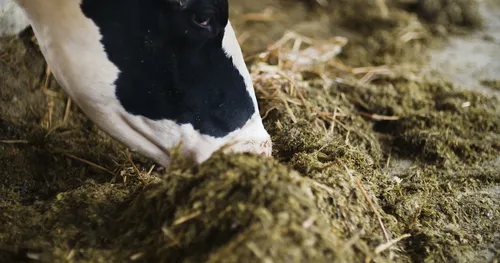
Step 1. Choose maize that meets your energy requirements
Maize is an important energy source in the ration. Much of that energy comes from starch in the cob, but a high starch content does not tell the whole story. For silage maize, yield and the digestibility of the stems and leaves also matter. First, decide how you want to use the maize: will you harvest the whole plant for silage, harvest it as MKS or CCM, or harvest only the grain? Then compare varieties for starch, total feed value and energy yield: how much usable energy does a hectare produce?
Next, choose a variety that suits your fields and can mature properly under your conditions. Maize grown on wetter clay fields has a different growth pattern from maize grown on higher-lying sandy soils. Use independent variety trials to compare varieties within the same maturity group (FAO).
Harvest timing then determines how much of that quality you can utilise. If you harvest too wet, nutrients can be lost through silage effluent. If you harvest too dry, the maize is harder to compact, leaving more air trapped inside. For maize silage, aim for a whole-plant dry matter content of approximately 32–38%. At this level, you combine a good energy yield with maize that can still be compacted and preserved effectively.
Practical tip
Start by determining the proportion of maize silage in your total ration. Is it high? Choose a maize variety with high cell wall digestibility. Is the proportion lower? Choose a variety with a higher starch content.
Step 2. Usable protein from grassland
The foundation for usable protein from grass lies in choosing a grass species that suits the soil, intended use, resistance requirements, persistence and desired yield. A field mainly used for cutting requires different management and characteristics from one that is intensively grazed. Herbs and clovers also provide a different feed value from grass alone. Choosing the right grass seed is therefore an important starting point.
Fertilisation, growing conditions and cutting date then determine what you actually harvest. Consider both quantity and quality. As grass matures, the proportion of stems and fibre increases and digestibility declines. A heavier cut may therefore produce more kilograms but contain less feed value per kilogram of dry matter.
Alongside protein, sugar, digestibility, fibre structure and dry matter yield also matter. The balance between sugar and protein deserves particular attention. Lactic acid bacteria use sugars to acidify the silage. Protein-rich grass with little sugar is often harder to preserve because protein buffers acidification.
More crude protein does not automatically mean more milk, either. A high protein content can coincide with a modest amount of intestinally digestible protein (DVE), resulting in a different nutritional value from what you might expect. Look beyond the crude protein percentage and ensure that protein and available energy are well matched.
Decide in advance what quality you want to harvest, and align your mixture selection, fertilisation and cutting management accordingly. Also consider the possibilities of overseeding. Where there are gaps in the sward, overseeding often delivers benefits that outweigh its cost by directly introducing grass varieties that can be utilised efficiently.
Practical tip
A fresh grass sample can help determine the actual feed value and guide the timing of fertilisation, cutting or overseeding. After harvest, assess both nutrient concentrations and feed value yield per hectare to obtain a complete picture.
3. Preserve what you have harvested
You want to preserve the energy and protein produced in the field right through to the feed barrier. After cutting, the crop initially continues to respire and consume sugars. Keep the field period as short as possible and aim for a suitable dry matter content: 30–40% for grass silage and 32–38% for maize silage. Also ensure that machinery is clean, both in the field and on the silage clamp.
Good preservation depends on limiting oxygen and achieving rapid acidification. Once oxygen levels in the silage are low, lactic acid bacteria can convert sugars into lactic acid, lowering the pH. However, not every crop is equally easy to preserve. Very wet, dry or low-sugar grass, and grass containing clovers and herbs, each require particular attention during ensiling. Harvesting a high-protein crop also calls for an approach that protects protein quality during ensiling. A suitable silage additive can help. Is your main aim to promote acidification or limit heating after opening? Some additives promote lactic acid production; others inhibit yeasts and moulds, as does a silage protectant that actively targets Clostridia. Base your choice on the crop and conditions, and examine the evidence for the product’s effectiveness.
When filling the clamp, spread the crop in thin layers, compact it carefully and cover it immediately. Choose silage film for its sealing and oxygen-barrier properties. Tear resistance and tensile strength also make a difference, particularly in windy conditions. Silage management remains important after opening. Maintain a minimum feed-out rate of 1.5 m and keep the silage face clean and even. This limits the time during which oxygen can cause heating and loss of feed value.
Practical tip
Most silage additives do not contain enzymes, even though enzymes help soften the cell walls. Using a silage additive containing enzymes allows rumen bacteria to reach the contents of forage cells sooner, improving both the extent and speed of nutrient uptake.
Optimal feed efficiency comes from working together
Feed efficiency depends on how sowing, harvesting and preservation work together, rather than on each aspect alone. Use silage analyses and feeding results to assess your grass silage alongside maize and the other ration ingredients, and to inform your choices for the following season. A suitable maize variety, a well-considered grass mixture and careful preservation complement one another to produce high-quality forage whose energy and protein can be fully utilised. That is optimal feed efficiency!